


The China–United States shipping market has entered one of the most intense peak seasons seen in recent years. Across major export hubs including Shanghai, Ningbo, Shenzhen, Qingdao, and Xiamen, exporters are facing severe vessel space shortages, container equipment imbalances, and rapidly rising freight costs.
According to recent trade statistics, China's exports surged significantly in May, with overseas demand accelerating faster than expected. As a result, shipping lines have struggled to provide sufficient capacity, creating a market-wide “space grabbing” and “container grabbing” phenomenon.
For many exporters, securing vessel space in June has become a race against time.
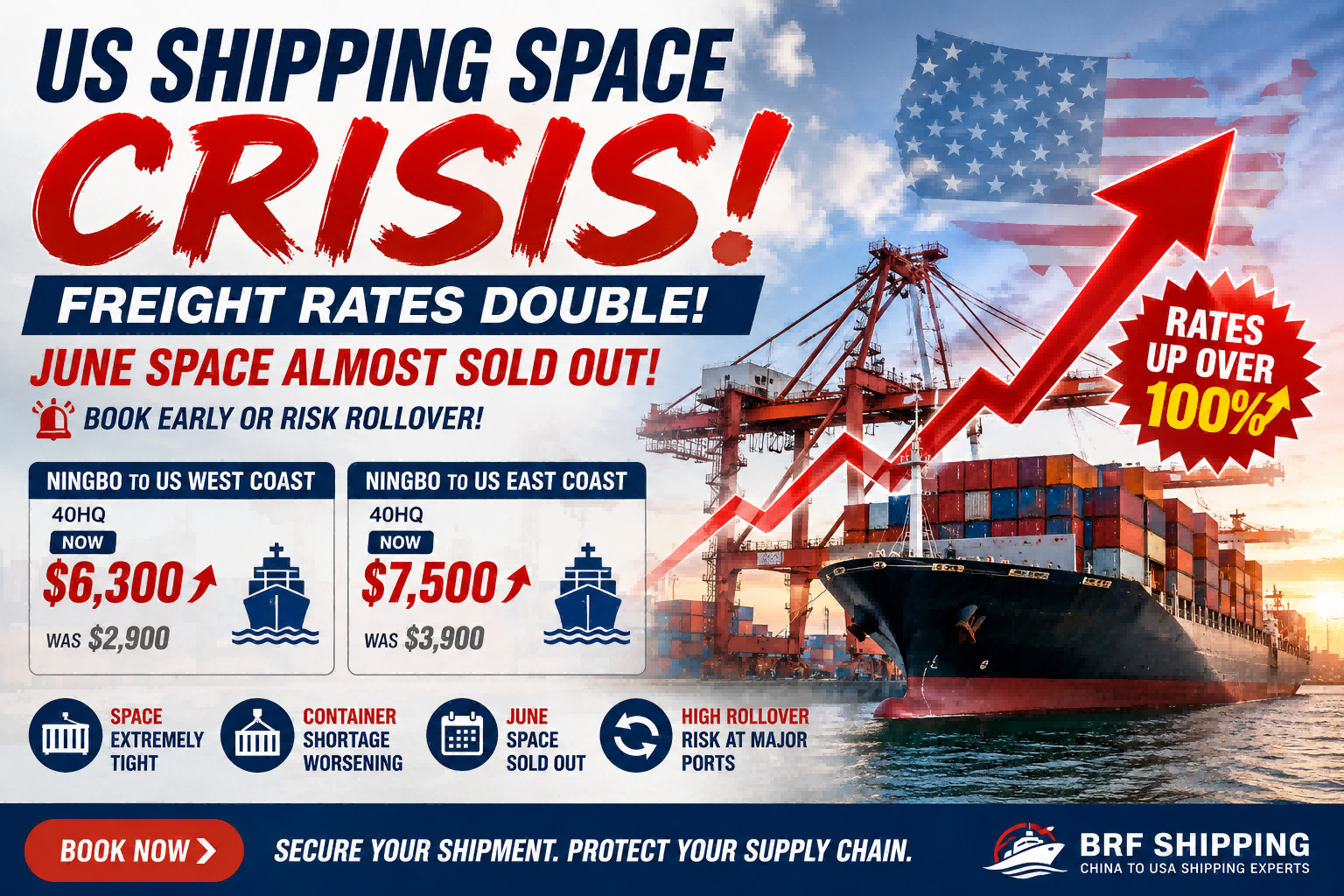
The most noticeable impact of the current market surge is the dramatic increase in freight rates.
Only weeks ago, a 40HQ container from Ningbo to the US West Coast averaged approximately USD 2,900. Multiple General Rate Increases (GRIs) and Peak Season Surcharges (PSS) have pushed rates close to USD 6,300 per container.
Meanwhile, shipments to the US East Coast have climbed from roughly USD 3,900 to USD 7,500, representing increases exceeding 100% within a single month.
Many carriers are now quoting rates that change weekly, making advance booking essential for maintaining supply chain stability.
US West Coast freight rates approaching USD 6,300 per 40HQ
US East Coast freight rates exceeding USD 7,500 per 40HQ
June vessel allocations nearly sold out
Frequent cargo rollovers at major Chinese ports
Equipment shortages impacting export schedules
Warehouse consolidation volumes exceeding traditional peak-season levels
American retailers continue replenishing inventories after periods of cautious purchasing.
Additionally, businesses are accelerating procurement plans for:
Holiday season sales
Back-to-school inventory
Consumer electronics launches
Home improvement products
Construction materials
Preparation for major international sporting events in North America
These factors have triggered a wave of early purchasing activity, significantly increasing cargo volumes.
While demand is growing, shipping capacity remains under pressure.
Ongoing geopolitical instability in the Middle East has tied up hundreds of thousands of TEUs in affected regions. At the same time, the long-awaited normalization of Red Sea transit routes remains uncertain.
Many vessels continue rerouting around the Cape of Good Hope, adding thousands of nautical miles to voyages and reducing overall fleet efficiency.
The result is fewer available vessels, longer transit times, and tighter equipment availability worldwide.
Exporters are increasingly encountering situations where cargo is ready but containers are unavailable.
Several major Asian export gateways have reported shortages of empty containers due to equipment imbalances caused by disrupted global vessel rotations.
This shortage further intensifies competition for available export capacity.
Another major trend in 2026 is the growing share of high-value and technology-driven exports moving from China to North America.
Products generating strong demand include:
Data center liquid cooling systems
AI infrastructure equipment
Aluminum fencing and gates
WPC fencing and decking
Smart pet products
Portable air conditioners
Seasonal cooling appliances
Renewable energy components
Because these products often carry higher profit margins and strict delivery deadlines, shippers are willing to pay premium freight rates to secure vessel space.
Many June and early July sailings are already full. Exporters should secure bookings as soon as production schedules are confirmed.
Using ports such as Qingdao, Tianjin, Dalian, Xiamen, or Ningbo may provide additional routing flexibility compared with heavily congested gateways.
Where possible, negotiate fixed-rate agreements to reduce exposure to weekly rate increases.
Professional logistics providers can access multiple carrier contracts and identify alternative sailing options when space becomes limited.
At BRF Shipping, we continue helping exporters secure reliable space despite the current market challenges.
Our services include:
✓ FCL Shipping from China to USA
✓ LCL Consolidation Services
✓ Door-to-Door Shipping Solutions
✓ Customs Clearance Support
✓ Warehousing and Consolidation
✓ DDP and DDU Shipping Services
✓ Priority Vessel Space Allocation During Peak Season
We operate through major Chinese ports including:
Shanghai
Ningbo
Qingdao
Tianjin
Dalian
Xiamen
Shenzhen
Laem Chabang
Ho Chi Minh
Phnom Penh
Sihanouk
allowing customers to access flexible routing options even during periods of severe market congestion.
Industry analysts expect the current surge to remain strong through the summer shipping season.
However, as emergency inventory replenishment slows and additional capacity enters the market, freight rates may gradually stabilize later in the year.
In the short term, exporters should prepare for:
Elevated freight costs
Limited vessel space
Potential cargo rollovers
Longer booking lead times
Businesses that plan ahead and secure logistics resources early will be best positioned to maintain supply chain continuity and protect delivery commitments.
The current China–USA shipping market is experiencing a rare combination of explosive demand and constrained supply. Freight rates have doubled, vessel space is scarce, and container shortages continue to challenge exporters.
For companies shipping construction materials, aluminum products, WPC fencing, industrial equipment, consumer goods, or technology products to North America, early planning has become more important than ever.
Partnering with a reliable logistics provider such as BRF Shipping can help ensure cargo moves efficiently despite ongoing market volatility.
telephone: +86 13869820502
Whatsapp & Wechat: +86-13869820502
E-mail: Quotation@brfshippinggroup.com
Copyright © 2025 BRF SHIPPING GROUP All Rights Reserved. Powered by hicheng
