


When importing products from China, T/T payment, also known as Telegraphic Transfer or bank wire transfer, is one of the most widely used international payment methods. It allows overseas buyers to send money directly from their bank account to a Chinese supplier’s bank account.
For global importers, T/T payment is popular because it is simple, fast, and widely accepted by Chinese manufacturers, trading companies, and exporters. However, buyers must handle it carefully to avoid risks such as wrong bank details, supplier fraud, payment delays, or quality disputes.
At BRF Shipping, we help international buyers not only arrange shipping from China but also understand the key steps of safe importing, from supplier coordination to customs clearance and final delivery.
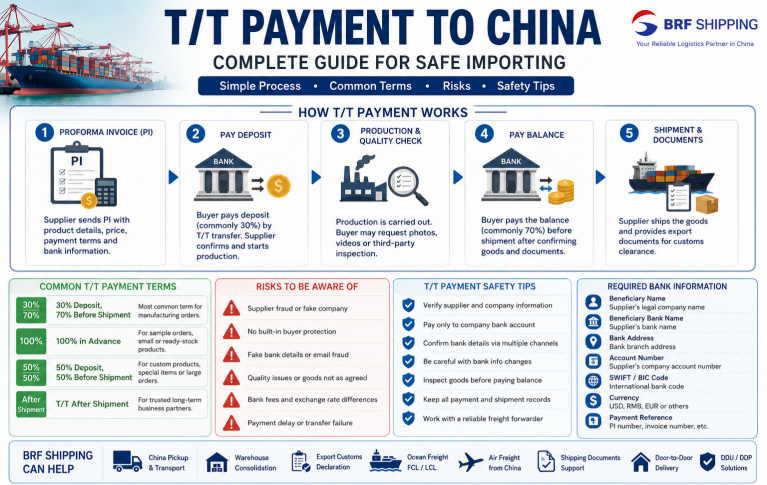
A typical T/T payment process usually includes the following steps:
Before payment, the supplier provides a Proforma Invoice, often called PI. This document usually includes:
Product name
Quantity
Unit price
Total amount
Payment terms
Supplier bank details
Delivery terms
Shipping arrangement
Before sending money, buyers should carefully check whether the supplier name, company bank account, invoice amount, and product details are correct.
The most common T/T payment term in China is:
30% deposit before production and 70% balance before shipment.
After the supplier receives the deposit, production usually begins.
During production, buyers should ask for updates, photos, videos, packing details, or inspection reports. For first-time suppliers or large-value orders, a third-party inspection is strongly recommended.
Once the goods are completed and ready for shipment, the supplier usually asks for the remaining balance. Buyers should confirm product quality, packing condition, and shipment schedule before paying the final 70%.
After receiving full payment, the supplier arranges delivery to the warehouse, factory pickup point, or port. Shipping documents may include:
Commercial Invoice
Packing List
Bill of Lading
Export customs documents
Certificate of Origin
Insurance document, if required
BRF Shipping can assist with China pickup, export customs declaration, ocean freight, air freight, warehouse consolidation, and door-to-door delivery.
This is the most common payment method for importing from China. It balances supplier production costs and buyer control before shipment.
Best for:
Regular import orders
Customized goods
Medium-value shipments
Manufacturing orders
This means the buyer pays the full amount before production or shipment.
Usually used for:
Sample orders
Small trial orders
Ready-stock goods
Low-value products
For new suppliers, buyers should be careful with 100% advance payment.
This payment term is often used for custom products, special materials, or products requiring higher upfront production costs.
Best for:
Custom-made products
Large production orders
Products with special molds
High material cost orders
This is usually only available after long-term cooperation. It is less common because it creates more risk for the supplier.
Best for:
Trusted long-term buyers
Regular monthly shipments
Established business relationships
T/T payment is usually faster than many traditional trade finance methods. In many cases, an international wire transfer may arrive within several business days, depending on the banks and countries involved.
Most Chinese exporters accept T/T payment. Whether you are importing building materials, machinery, furniture, packaging, consumer goods, auto parts, or industrial products, T/T is usually available.
Compared with Letter of Credit, T/T payment requires less paperwork and is easier for small and medium-sized importers.
Once you build a stable relationship with a verified supplier, T/T payment can make repeat orders faster and more efficient.
Although T/T is convenient, importers should understand the risks.
If the supplier is not verified, the buyer may send money to a fake company or unreliable seller.
T/T payment does not provide strong built-in buyer protection. Once the money reaches the supplier’s account, it can be difficult to recover.
Email hacking and invoice fraud are common risks in international trade. Scammers may send fake bank account details that look similar to the supplier’s real account.
If the buyer pays the full balance before checking the goods, it may be difficult to solve quality disputes after shipment.
International wire transfers may include sending bank fees, intermediary bank fees, receiving bank fees, and currency exchange differences.
Before sending any deposit, check the supplier’s business license, company name, address, factory photos, export experience, website, and previous shipment records.
For large orders, consider using a third-party factory audit or inspection service.
Always transfer money to the supplier’s official company bank account. Avoid sending large payments to personal accounts.
The beneficiary name should match the supplier’s legal company name.
Before payment, confirm the bank information through multiple channels, such as email, phone call, video call, or official company contact.
Check:
Beneficiary name
Bank name
Bank address
Account number
SWIFT/BIC code
Currency
Invoice number
If the supplier suddenly changes bank details, stop the payment immediately and verify again. This is a common warning sign of payment fraud.
Save all invoices, contracts, bank receipts, emails, inspection reports, packing photos, and shipping documents. These records are useful for accounting, customs clearance, and dispute handling.
For first-time orders or high-value shipments, do not pay the balance only based on the supplier’s message. Ask for photos, videos, packing list, inspection report, or arrange a third-party inspection.
A professional freight forwarder can help buyers coordinate cargo pickup, warehouse loading, customs declaration, shipping documents, ocean freight, air freight, and final delivery.
BRF Shipping supports global importers with reliable shipping solutions from China to the USA, Canada, Australia, New Zealand, Europe, the Middle East, Southeast Asia, and other major markets.
| Required Information | Description |
|---|---|
| Beneficiary Name | Supplier’s legal company name |
| Beneficiary Bank Name | Supplier’s receiving bank |
| Bank Address | Bank branch address |
| Account Number | Supplier’s company bank account |
| SWIFT/BIC Code | International bank identification code |
| Currency | USD, RMB, EUR, or other agreed currency |
| Payment Reference | PI number, invoice number, or order number |
Always make sure the beneficiary name matches the supplier’s registered company name.
| Item | T/T Payment | L/C Payment |
|---|---|---|
| Speed | Faster | Slower |
| Paperwork | Simple | More complex |
| Bank Fees | Usually lower | Usually higher |
| Buyer Protection | Lower | Higher |
| Supplier Acceptance | Very common | Common for large orders |
| Best For | Small and medium orders | Large or high-risk orders |
For most small and medium importers, T/T is practical and efficient. For large contracts or high-risk orders, Letter of Credit may provide stronger protection but requires more paperwork and bank procedures.
T/T payment is suitable when:
The supplier has been verified
The order value is manageable
The buyer confirms bank details carefully
The payment term includes deposit and balance
Goods can be inspected before final payment
Shipping documents are properly arranged
T/T payment may not be suitable when:
The supplier refuses verification
The bank account is personal or suspicious
The supplier asks for 100% advance payment on a large order
The company name and bank account name do not match
Bank details change suddenly
The supplier refuses inspection before shipment
Be careful if you notice any of these red flags:
Supplier only accepts personal account payment
Company name does not match bank account name
Supplier refuses video call or company verification
Price is much lower than normal market level
Supplier pushes you to pay urgently
Bank account details suddenly change
Email address looks unofficial or slightly different
Supplier refuses inspection before balance payment
If any warning sign appears, pause the payment and verify all details again.
International trade is not only about payment. After the supplier receives payment, buyers still need to arrange cargo pickup, export customs clearance, container loading, freight booking, shipping documents, destination customs clearance, and final delivery.
BRF Shipping provides professional China export logistics services, including:
China supplier pickup
Warehouse consolidation
FCL ocean freight
LCL ocean freight
Air freight from China
Export customs declaration
Shipping document support
DDU and DDP shipping solutions
Door-to-door delivery
Container loading coordination
Import logistics planning
Whether your supplier is located in Qingdao, Shanghai, Ningbo, Shenzhen, Guangzhou, Tianjin, Yiwu, Foshan, or other Chinese cities, BRF Shipping can help make your import process safer, smoother, and more efficient.
T/T payment to China is one of the most common and practical payment methods in international trade. It is fast, simple, and widely accepted by Chinese suppliers. However, buyers should never ignore payment safety.
Before sending money, always verify the supplier, confirm bank details, avoid personal accounts, keep transaction records, and inspect goods before paying the final balance.
With careful payment control and reliable logistics support from BRF Shipping, importing from China can become safer, more transparent, and more cost-effective.
T/T stands for Telegraphic Transfer. It is also called bank wire transfer. It allows buyers to send money electronically from their bank account to the supplier’s bank account.
T/T payment can be safe if the supplier is verified and the payment is sent to an official company bank account. Buyers should always confirm bank details before sending money.
The most common term is 30% deposit before production and 70% balance before shipment.
It usually takes several business days, depending on the banks, countries, currency, intermediary banks, and compliance checks.
Once the money arrives in the supplier’s account, it is usually difficult to reverse. If you notice a mistake, contact your bank immediately.
For small sample orders, 100% advance payment may be acceptable. For large orders or new suppliers, a deposit and balance payment structure is safer.
Check product photos, packing details, inspection report, commercial invoice, packing list, and shipping plan before paying the final balance.
Do not pay immediately. Confirm the change through phone call, video call, official email, and written confirmation.
T/T is faster and simpler. L/C offers stronger buyer protection but is more complex and costly. The best choice depends on order value and supplier trust level.
Yes. BRF Shipping can help arrange cargo pickup in China, warehouse consolidation, customs declaration, sea freight, air freight, and door-to-door delivery.
telephone: +86 13869820502
Whatsapp & Wechat: +86-13869820502
E-mail: Quotation@brfshippinggroup.com
Copyright © 2025 BRF SHIPPING GROUP All Rights Reserved. Powered by hicheng
