


International trade relies heavily on clear shipping agreements. One of the most widely used Incoterms in global logistics today is FCA (Free Carrier). Whether you are importing goods from China, managing containerized cargo, or coordinating multimodal transportation, understanding FCA shipping terms can help reduce risk, lower costs, and improve shipping efficiency.
This comprehensive guide by BRF SHIPPING GROUP explains everything you need to know about FCA shipping, including buyer and seller responsibilities, risk transfer, FCA vs FOB comparisons, advantages, disadvantages, and practical examples for international shipments.
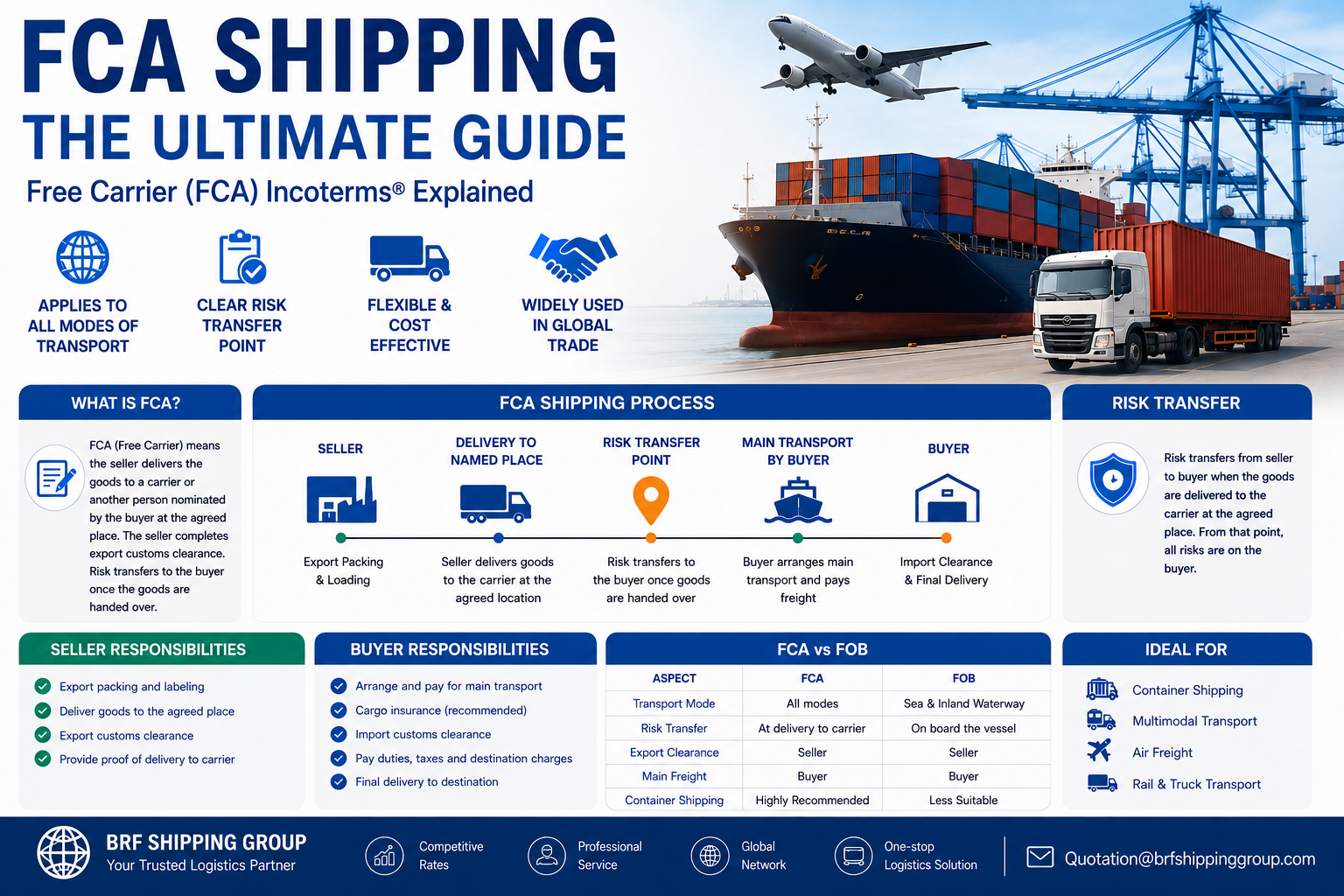
FCA stands for Free Carrier, one of the official Incoterms® rules established by the International Chamber of Commerce (ICC).
Under FCA shipping terms:
The seller delivers goods to a carrier or freight forwarder nominated by the buyer
The seller completes export customs clearance
Risk transfers to the buyer once goods are handed over at the agreed location
The buyer manages the main international transportation
FCA is commonly used for:
Container shipping
Air freight
Rail freight
Truck transportation
Multimodal logistics operations
Unlike FOB, FCA works for almost all transport methods, making it highly flexible for modern global trade.
The most important part of FCA shipping is the named place of delivery.
The contract must clearly specify where the seller hands over the cargo to the buyer’s carrier.
Examples:
FCA Shenzhen Warehouse
FCA Shanghai Port Terminal
FCA Ningbo CY
FCA Guangzhou Airport
There are generally two common FCA delivery situations:
The seller loads goods onto the buyer’s arranged vehicle at the seller’s warehouse or factory.
Risk transfers once cargo is loaded.
The seller transports cargo to a specified logistics facility, terminal, or freight forwarder warehouse.
The buyer assumes risk after cargo handover.
Clear delivery point definitions help avoid disputes and unnecessary charges.
Under FCA Incoterms 2020, the seller is responsible for:
| Seller Responsibility | Description |
|---|---|
| Packaging & Labeling | Proper export packing and marking |
| Export Customs Clearance | Export licenses and customs filing |
| Inland Transportation | Delivery to agreed FCA point |
| Cargo Handling | Loading if delivery occurs at seller premises |
| Delivery Documentation | Proof of handover to carrier |
The seller’s responsibility ends once the cargo is successfully delivered to the buyer’s nominated carrier.
The buyer takes responsibility after the FCA handover point.
Buyer obligations include:
| Buyer Responsibility | Description |
|---|---|
| Main Freight Booking | Ocean freight, air freight, rail, or trucking |
| Cargo Insurance | Optional but recommended |
| Import Customs Clearance | Duties, taxes, and import compliance |
| Destination Charges | Port fees and terminal charges |
| Final Delivery | Inland trucking to warehouse or project site |
Because buyers control the international freight, FCA offers greater flexibility for importers with established logistics networks.
One of the biggest advantages of FCA shipping is the clearly defined risk transfer point.
Risk transfers:
When goods are loaded onto the buyer’s vehicle at seller premises
OR
When cargo is handed over to the buyer’s nominated carrier at the named location
After this point:
Cargo damage
Shipping delays
Freight issues
Insurance claims
become the buyer’s responsibility.
Many importers confuse FCA and FOB shipping terms.
Here is the main difference:
| Aspect | FCA | FOB |
|---|---|---|
| Transport Mode | Any mode | Ocean freight only |
| Risk Transfer | At carrier handover | On vessel loading |
| Container Shipping | Recommended | Less suitable |
| Air Freight Use | Yes | No |
| Export Clearance | Seller | Seller |
| Main Freight | Buyer | Buyer |
Industry logistics professionals often recommend FCA for containerized cargo because it avoids confusion regarding terminal handling and vessel loading responsibilities.
FCA supports:
Ocean freight
Air freight
Rail transport
Trucking
Combined transport solutions
This flexibility makes FCA ideal for modern supply chains.
Buyers can choose their own freight forwarders and negotiate better shipping rates.
This is especially useful for experienced importers shipping from China.
The seller’s risk ends earlier compared to CIF or DDP shipping terms.
Unlike FOB, FCA aligns better with containerized cargo handling at terminals and consolidation warehouses.
FCA minimizes misunderstandings between buyers and sellers by defining exact delivery responsibilities.
Although FCA is highly practical, there are also some drawbacks.
The buyer controls the international freight process, requiring coordination with:
Shipping lines
Freight forwarders
Customs brokers
Trucking companies
Risk shifts relatively early in the shipping process.
Buyers should strongly consider cargo insurance.
If the buyer’s carrier arrives late or documentation is incomplete, storage and demurrage charges may occur.
Here’s a typical FCA China shipping scenario:
Product: Aluminum Fence Panels
Origin: Foshan, China
Incoterm: FCA Shenzhen Warehouse
Factory packing
Export customs clearance
Trucking to Shenzhen warehouse
Ocean freight booking
Marine insurance
Destination customs clearance
Truck delivery in destination country
Once the cargo reaches the buyer’s freight forwarder warehouse in Shenzhen, the buyer assumes all shipping risk and cost responsibilities.
A professional freight forwarder plays a critical role under FCA shipping terms.
An experienced China freight forwarder can assist with:
Export documentation
Customs filing
Warehouse coordination
Container booking
Cargo consolidation
Bill of lading handling
Final delivery arrangements
According to logistics community discussions, FCA is especially popular for containerized cargo and multimodal shipping because it offers greater operational flexibility compared to FOB.
Always specify the exact FCA delivery location.
Incorrect:
FCA China
Correct:
FCA Shanghai Yangshan Terminal
Risk transfers early under FCA, making insurance highly recommended.
FOB applies mainly to traditional ocean freight loading onto vessels, while FCA better fits containerized shipments.
For modern container shipping, many logistics experts prefer FCA over FOB because:
It matches terminal handling practices
It supports multimodal transport
It clearly defines handover responsibility
It reduces loading disputes
FOB still remains common for bulk cargo and traditional sea freight transactions.
BRF SHIPPING GROUP provides professional FCA shipping solutions from major China ports including:
Shenzhen
Shanghai
Ningbo
Qingdao
Tianjin
Xiamen
Dalian
Our services include:
Export customs clearance
Cargo pickup
Warehousing
Container loading
Freight booking support
Door-to-door delivery
DDP / DAP / FCA logistics solutions
Whether you are shipping construction materials, aluminum products, machinery, furniture, or commercial cargo, BRF SHIPPING GROUP helps simplify your international shipping process.
Yes. FCA supports all transportation modes including air freight.
The seller handles export customs clearance.
No. Insurance is optional and usually arranged by the buyer.
Yes. FCA is often considered better than FOB for containerized cargo.
The buyer books and pays for the main carriage.
FCA (Free Carrier) is one of the most flexible and efficient Incoterms used in international trade today. It provides clear responsibility allocation, supports all transport modes, and is especially effective for container shipping from China.
For importers and exporters seeking better logistics control, lower freight costs, and simplified shipping coordination, FCA shipping terms offer an excellent solution.
Partnering with an experienced logistics company like BRF SHIPPING GROUP ensures your FCA shipments are handled professionally from factory pickup to final destination.
telephone: +86 13869820502
Whatsapp & Wechat: +86-13869820502
E-mail: Quotation@brfshippinggroup.com
Copyright © 2025 BRF SHIPPING GROUP All Rights Reserved. Powered by hicheng
