


Importing goods into Australia requires more than booking an ocean freight or air freight shipment. For importers, wholesalers, manufacturers, e-commerce sellers and project cargo buyers, the real challenge often begins after the goods arrive at an Australian port or airport. Customs clearance, import duties, GST, biosecurity inspection, terminal release, truck delivery and final receiving all need to be handled correctly.
BRF Shipping, operated by CHINA BRF LOGISTICS, provides a complete international freight solution for businesses shipping cargo to Australia. Our services cover sea freight, air freight, export customs clearance, import documentation support, Australia customs clearance coordination, port pickup, container delivery, warehouse handling and door-to-door delivery.
Whether your shipment is from China to Australia, Thailand to Australia, or other Asian loading ports, BRF Shipping helps customers reduce delays, avoid document problems and complete the import process more smoothly.
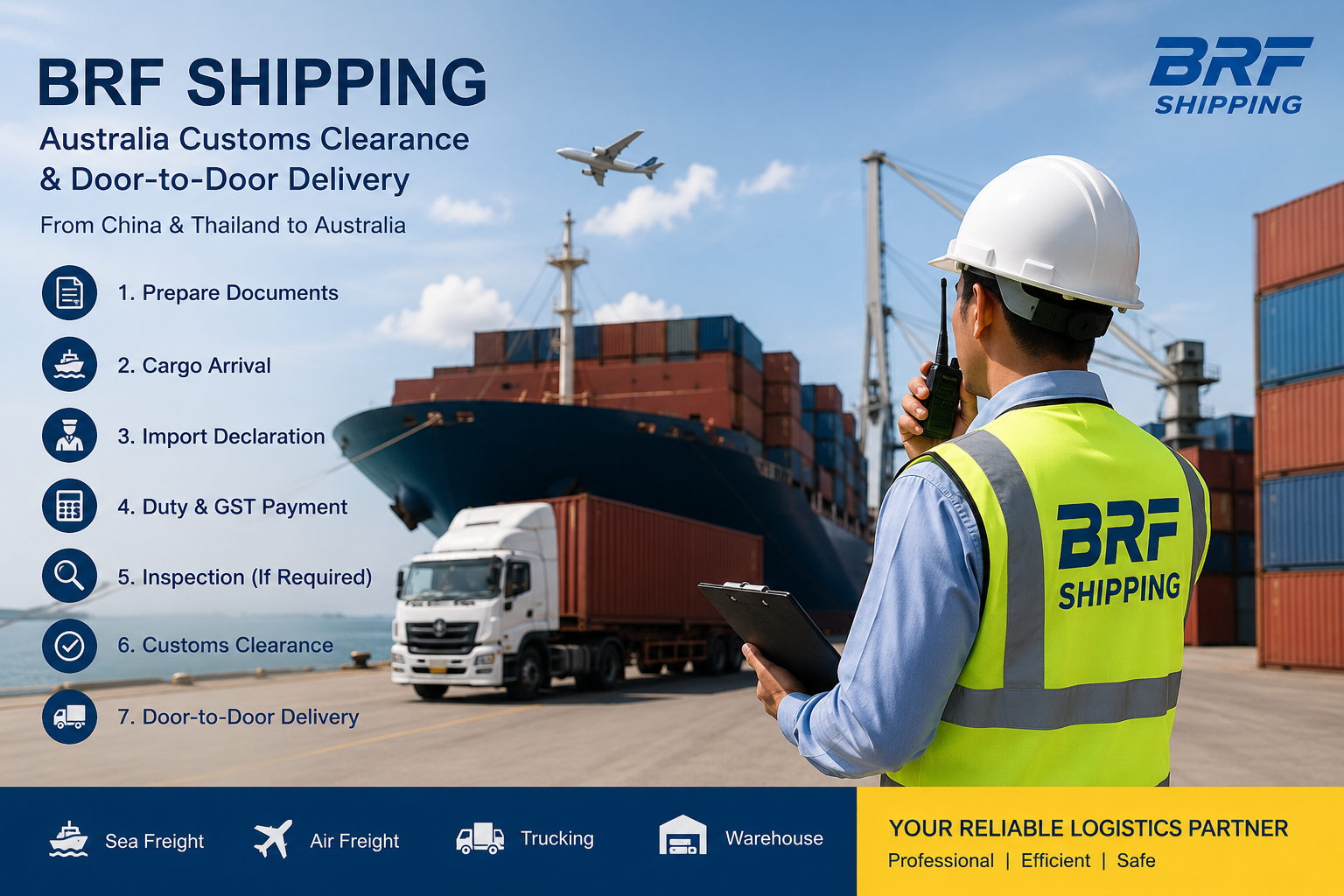
Australia customs clearance is the process of declaring imported goods to the Australian Border Force and other relevant authorities before the cargo can legally enter the Australian market. The process normally includes document submission, cargo classification, duty and GST assessment, biosecurity review, possible inspection, customs release and delivery arrangement.
For commercial shipments, the importer or appointed customs broker usually needs to submit an import declaration. The information must match the commercial invoice, packing list, bill of lading or air waybill, product description, HS code, country of origin and cargo value.
If the documents are incomplete or inaccurate, the shipment may be delayed at the port, airport or bonded warehouse. In some cases, additional storage fees, inspection charges, demurrage or detention costs may occur.
Successful Australia customs clearance starts before the cargo leaves the origin country. Before shipping to Australia, importers should prepare a complete document set.
Common documents include:
Commercial Invoice
Packing List
Bill of Lading or Air Waybill
Import Declaration information
Certificate of Origin, if applicable
Packing Declaration
Fumigation Certificate or treatment certificate, if wood packaging is used
Import Permit, if required for regulated goods
Product certificates, test reports or compliance documents, if applicable
BRF Shipping can help customers check the basic document structure before shipment. This is especially important for FCL containers, LCL cargo, machinery, building materials, furniture, textiles, industrial products, chemical-related goods, wooden products and cargo packed with timber pallets or crates.
For shipments from China to Australia, a valid Certificate of Origin may help importers claim preferential duty treatment under the China-Australia Free Trade Agreement when the goods meet origin rules. DFAT notes that certificates of origin must be issued by authorised bodies and may be requested by customs officials.
When cargo arrives in Australia, the carrier, shipping line, airline or terminal operator will issue arrival information. Common Australian arrival ports include Sydney, Melbourne, Brisbane, Fremantle, Adelaide and other major terminals.
For sea freight, the process may involve container discharge, terminal handling, cargo availability notice and release coordination. For air freight, cargo usually moves faster, but documentation must still be accurate and complete.
The original BRF Logistics article explains that after cargo arrives in Australia, the freight forwarder or customs broker submits customs declaration information and prepares the cargo for further review and release.
After arrival, the importer or licensed customs broker lodges the import declaration. The Australian Border Force uses import declarations to clear imported goods from customs control into home consumption or warehouse entry.
During this stage, customs authorities may review:
Importer details
Supplier details
Goods description
HS code classification
Customs value
Country of origin
Freight and insurance cost
Duties, GST and import charges
Permits or certificates
Biosecurity risk
Australia uses the Integrated Cargo System for cargo reporting and customs-related electronic processing. ABF states that cargo status information is available through the ICS and transmitted to relevant stakeholders.
One of the most important parts of Australia customs clearance is cost calculation. Importers may need to pay customs duty, GST and import processing charges before the goods can be released.
GST on taxable importations is generally calculated at 10% of the value of the taxable importation. According to the Australian Taxation Office, the taxable importation value includes the customs value of the goods plus relevant transport, insurance and duty components.
Customs duty depends on the product HS code, origin country and applicable trade agreement. Not every product has the same duty rate. Some goods may be duty-free, while others may attract import duty unless a concession or free trade agreement applies. ABF also states that goods imported into Australia are generally liable for duties and taxes unless an exemption or concession applies.
BRF Shipping can assist customers in coordinating with customs brokers, checking document consistency and helping importers understand the possible cost structure before cargo arrival.
Australia has strict biosecurity controls. Some goods may require review by the Department of Agriculture, Fisheries and Forestry. Products such as food, agricultural goods, timber, bamboo, wooden furniture, plant products, animal-related products and cargo with wooden packaging may face additional checks.
Wood packaging is one of the most common causes of delays in Australia imports. Solid timber or bamboo packaging must be treated and declared. The Department of Agriculture explains that packaging made from solid timber or bamboo must be treated and declared on the packing declaration, and untreated or non-compliant packaging may require mandatory treatment, export or disposal at the importer’s expense.
For containerized cargo using wooden pallets, crates or dunnage, importers should confirm whether the packaging meets ISPM 15 or other accepted Australian import conditions. Proper packing declaration and treatment documentation can reduce the risk of quarantine delays.
Once customs and biosecurity requirements are satisfied, the cargo can be released from customs control. At this stage, the next task is cargo pickup and inland transportation.
For FCL containers, BRF Shipping can coordinate with local partners for container pickup from the port, delivery to the consignee’s warehouse and empty container return. For LCL shipments, cargo may need to be unpacked at a bonded warehouse or container freight station before final delivery.
Delays may happen if:
Documents do not match
Duty or GST is not paid on time
Cargo is selected for inspection
Wood packaging documents are missing
Import permits are not prepared
The consignee is not ready to receive cargo
Delivery address has access restrictions
Container free time expires
BRF Shipping helps customers manage these steps in advance to reduce avoidable costs.
Door-to-door delivery means the freight forwarder manages the shipment from origin pickup to the final delivery address. This may include supplier pickup, export customs clearance, international freight, destination customs coordination, port release, truck delivery and final receiving.
BRF Shipping provides flexible delivery solutions for different cargo types:
FCL container delivery
LCL cargo delivery
Air freight delivery
Warehouse-to-door service
Port-to-door trucking
DDP shipping coordination
Project cargo delivery
Commercial warehouse delivery
For importers who do not have their own logistics team in Australia, door-to-door shipping can save time and reduce communication problems between suppliers, carriers, brokers and local truckers.
BRF Shipping supports customers shipping goods to Australia from China, Thailand and other Asian origins. Our main Australia-related services include:
BRF Shipping arranges FCL and LCL sea freight from major Chinese ports to Australia, including Qingdao, Shanghai, Ningbo, Shenzhen, Guangzhou, Tianjin and Xiamen.
For manufacturers and exporters in Thailand, BRF Shipping provides international freight solutions from Thai ports to Australian destinations.
We help customers organize documents, coordinate with customs brokers and support import clearance communication.
After customs release, BRF Shipping can assist with cargo pickup, container transport and final door delivery.
For customers who need simplified import solutions, BRF Shipping can provide DDU and DDP-style shipping coordination depending on cargo type, destination and compliance requirements.
Whether you are shipping a full container, small consolidated cargo or urgent air shipment, BRF Shipping can design a suitable freight plan.
Choosing the right logistics partner is important for Australia imports. A low freight rate alone does not guarantee a smooth shipment. Importers also need reliable document handling, customs coordination, arrival tracking, local delivery planning and cost control.
BRF Shipping offers:
Experienced China and Asia export coordination
Sea freight and air freight solutions
Customs document support
FCL and LCL shipment handling
Australia destination delivery coordination
DDU and DDP service options
Supplier pickup and cargo consolidation
Clear communication before and after shipment
Support for commercial cargo, project cargo and containerized shipments
CHINA BRF LOGISTICS was founded in 2017 and describes itself as an NVOCC freight forwarder with international logistics experience.
BRF Shipping can support many types of commercial goods, including:
Building materials
Furniture
Aluminum products
Machinery and equipment
Textiles and fabrics
Auto parts
Packaging materials
Household goods
Industrial products
E-commerce cargo
Project cargo
Containerized cargo
Before shipping restricted or sensitive goods, importers should confirm whether permits, certificates or special import conditions are required.
Normal shipments may clear quickly if documents are correct and no inspection is required. However, clearance time can be longer if customs requests additional documents, biosecurity inspection is required, or duty and GST payment is delayed.
Common documents include commercial invoice, packing list, bill of lading or air waybill, packing declaration, import declaration details, certificate of origin and permits if required.
Yes. GST on taxable importations is generally 10% of the taxable importation value. Importers should calculate GST together with customs value, duty, freight and insurance.
Wooden pallets, crates and dunnage must meet Australian biosecurity import requirements. Solid timber or bamboo packaging must be treated and declared, and non-compliant packaging may be treated, exported or disposed of at the importer’s expense.
Yes. BRF Shipping can coordinate international freight, customs clearance support, port pickup and door-to-door delivery for suitable shipments to Australia.
Australia customs clearance and door-to-door delivery require careful planning, accurate documents and professional coordination. From cargo arrival and import declaration to GST payment, biosecurity review, port release and final delivery, every step affects the total cost and delivery time.
BRF Shipping provides reliable logistics support for importers shipping goods from China, Thailand and other Asian origins to Australia. With sea freight, air freight, customs clearance support, port pickup and door-to-door delivery services, BRF Shipping helps businesses move cargo to Australia more efficiently and with fewer delays.
Contact BRF Shipping today for Australia customs clearance, China to Australia freight, Thailand to Australia shipping and door-to-door delivery solutions.
e-mail:Quotation@brfshippinggroup.com
whatsapp:+86 13869820502
telephone: +86 13869820502
Whatsapp & Wechat: +86-13869820502
E-mail: Quotation@brfshippinggroup.com
Copyright © 2025 BRF SHIPPING GROUP All Rights Reserved. Powered by hicheng
